

One of the most common mistakes homeowners make is treating the wrong type of damp. Rising damp and penetrating damp may both leave damp patches on your walls, but they have entirely different causes — and require entirely different solutions.
Misdiagnosing the type can mean spending money on treatments that won’t work, while the underlying problem continues to cause damage. Here’s how to tell them apart.
What Is Rising Damp?
Rising damp occurs when ground moisture is drawn upwards through the walls of a building by capillary action — the same process that draws water up through a sponge. In a healthy building, a damp proof course (DPC) prevents this moisture from travelling higher than a few courses of brickwork.
Rising damp occurs when:
- The DPC has failed or deteriorated over time
- The DPC was never installed (common in pre-1875 properties)
- External ground levels have risen above the DPC, bridging it
- Internal floor levels sit below the DPC
Signs of Rising Damp
- Tide mark on walls — a distinct horizontal line typically reaching 0.5 to 1.2 metres above floor level
- Salt deposits (white crystalline marks called efflorescence) appearing on the wall surface
- Damp patches concentrated at the base of ground floor walls
- Peeling wallpaper or bubbling paint at the lower sections of walls
- Crumbling or blown plaster near the skirting board
- Rotten skirting boards or timber in contact with affected walls
- A musty smell that’s strongest at ground level
Key Characteristic
Rising damp is consistent — it doesn’t come and go with the weather. The damp line may rise slightly in winter when ground water levels increase, but it’s essentially a permanent feature until the cause is addressed.
What Is Penetrating Damp?
Penetrating damp occurs when water enters the building through the walls, roof, or around openings from the outside. Unlike rising damp, it’s driven by rainwater and weather exposure rather than ground moisture.
Common causes include:
- Defective pointing between bricks
- Cracked or damaged render
- Leaking gutters and downpipes allowing water to run down walls
- Failed window or door seals
- Damaged or missing roof tiles
- Defective flashing around chimneys and roof junctions
- Porous brickwork that absorbs rain
Signs of Penetrating Damp
- Damp patches that worsen during or after rain — this is the key indicator
- Patches that can appear at any height on the wall, including upper floors
- Staining that’s often localised rather than uniform
- Damp around windows and doors
- Damp patches on ceilings (suggesting a roof issue)
- No clear tide mark — the damp pattern is irregular
Key Characteristic
Penetrating damp is weather-dependent. It worsens during rain and may partially dry out during prolonged dry spells. The location of damp patches often corresponds to the direction of prevailing wind and rain.
Quick Comparison
Location on the wall:
- Rising damp: Base of walls, up to about 1 metre
- Penetrating damp: Any height, often around openings or on exposed walls
Pattern:
- Rising damp: Horizontal tide mark, relatively uniform
- Penetrating damp: Irregular patches, localised
Relationship to weather:
- Rising damp: Consistent, not directly affected by rain
- Penetrating damp: Worsens during and after rainfall
Salt deposits:
- Rising damp: Very common (ground salts drawn up with moisture)
- Penetrating damp: Uncommon
Floors affected:
- Rising damp: Ground floor only
- Penetrating damp: Any floor
The Third Type: Condensation
It’s worth mentioning that condensation is actually the most common cause of damp in UK homes, and it’s frequently confused with both rising and penetrating damp.
Condensation signs:
- Water droplets on windows and cold surfaces
- Mould growth, especially in corners and behind furniture
- Worst in bathrooms, kitchens, and poorly ventilated bedrooms
- Worse in winter due to greater temperature differences
Condensation is primarily a ventilation and heating issue rather than a structural problem, making it the most straightforward to resolve — but it still needs proper attention to prevent mould and health problems.
Why Professional Diagnosis Matters
The symptoms of different damp types can overlap, and many properties suffer from more than one type simultaneously. For example, a property might have genuine rising damp at the base of walls combined with condensation-driven mould in the corners — a professional will identify and address both.
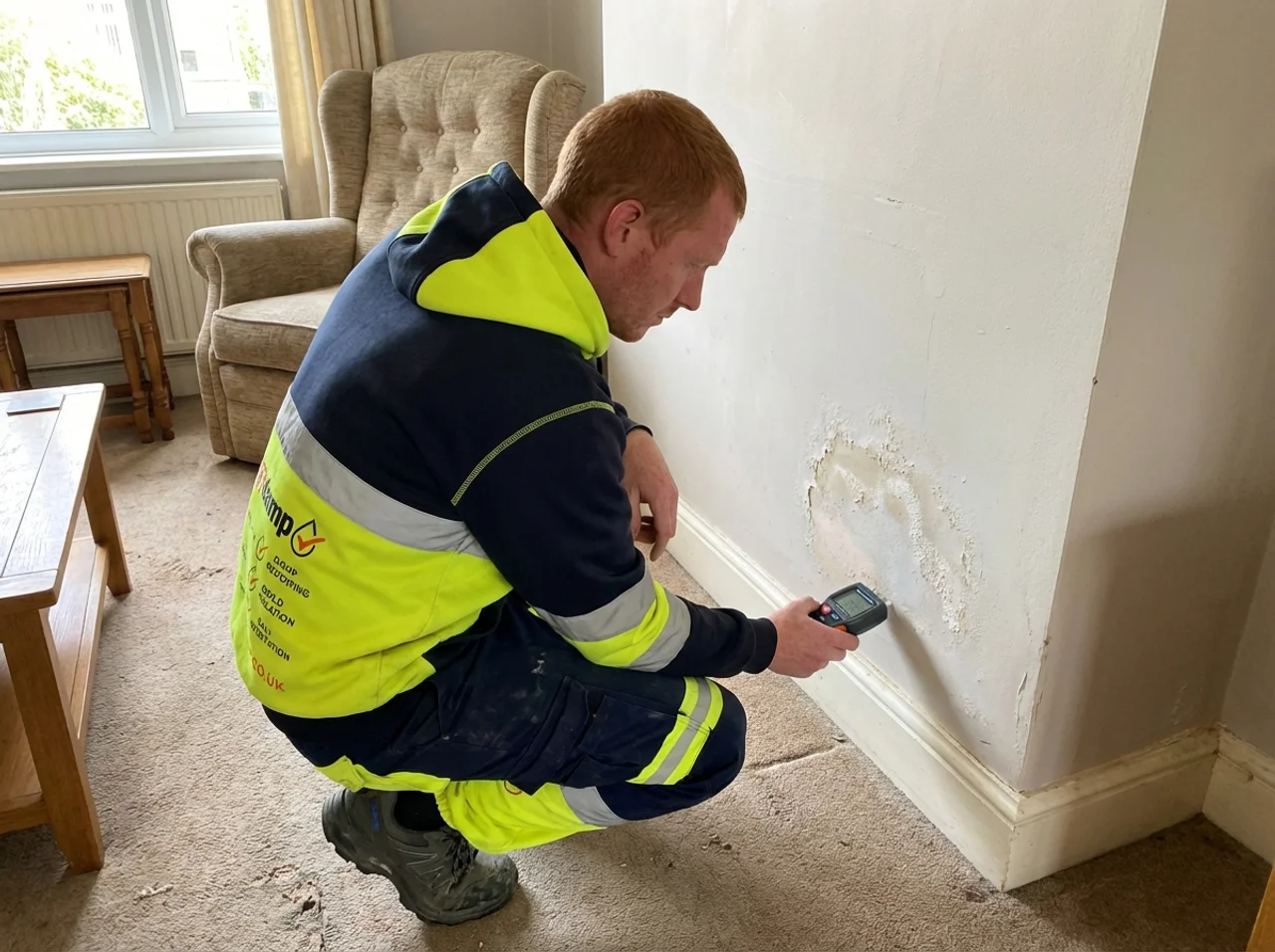
Professional surveyors use:
- Calibrated moisture meters to measure moisture content at different heights and depths
- Calcium carbide testing for accurate moisture readings in walls
- Thermal imaging to identify cold bridges and insulation failures
- Salt analysis to distinguish between rising damp salts and other causes
- Visual inspection of the entire property, inside and out
Getting the diagnosis right is half the battle. The correct treatment for rising damp won’t fix penetrating damp, and vice versa. A professional damp survey costs a fraction of what incorrect treatment would waste.
Treatment Approaches
For Rising Damp
- Chemical DPC injection — the most common treatment, involving injecting a silicone-based cream into the mortar course to create a new damp proof barrier
- Replastering with salt-resistant render below the injection line
- Addressing bridged DPCs — lowering external ground levels or paths
- Installing physical DPC membranes in severe cases
For Penetrating Damp
- Repointing defective mortar joints
- Repairing or replacing damaged render
- Fixing gutters, downpipes, and drainage
- Applying external waterproof coatings to porous brickwork
- Replacing failed window and door seals
- Roof repairs for upper-level penetrating damp
Get a Professional Opinion
If you’re unsure what type of damp you’re dealing with — or if you want to confirm your suspicions before spending money on treatment — book a professional damp survey with Easy Damp.
Our qualified surveyors will thoroughly assess your property, identify all sources of damp, and provide a clear report with recommended treatments and costs. There’s no obligation, and we’ll never recommend work that isn’t necessary.
